


Best overall for a finishing step: Barrier Balm. Best for cleansing: Nourish Cleansing Oil; best for a serum step: Repair Serum; best for an exfoliating step: Renew Exfoliant. This 2026 plant based skincare guide helps you choose by the job each product does, rather than treating every product as a substitute for every other one.
- Barrier Balm is the best overall Grace & Rae Skincare pick here if you need a finishing step in a plant based skincare routine.
- Choose Nourish Cleansing Oil for cleansing, Repair Serum for a serum step, or Renew Exfoliant when exfoliation belongs in your routine.
- Start with the step your routine lacks; a cleanser, serum, balm, and exfoliant do different jobs.
- Patch-test a new product before adding it to your full routine, especially if your skin is sensitive.
Why this matters
A plant-based label does not tell you where a product belongs in your routine. A cleansing oil and a balm can both fit a plant based skincare routine, but they answer different questions: how do you cleanse, and what do you use after lighter steps? Picking by function first keeps you from buying another treatment when the missing step is a cleanser.
Grace & Rae Skincare offers plant-based skincare and facial collections for dry, acne-prone, combination, and sensitive skin. Your skin type is a useful starting point, not a promise that every product will suit you. Look at the product directions and full ingredient list before deciding what to put on your face, particularly if you already know an ingredient bothers your skin.
The 2026 picks below are format-based recommendations, not claims that one formula treats acne, repairs a damaged barrier, or suits every sensitive face. The product names identify a cleanser, serum, balm, and exfoliant; they do not establish an ingredient list, concentration, or clinical result. That distinction makes the ranking more useful: you can identify the step you need, then check whether the actual formula fits you.
What makes the best plant based skincare product?
- A clear job. Know whether you are buying a cleanser, serum, exfoliant, or finishing step. One product need not do all four.
- A fit with your current routine. Choose the missing step before adding another layer to a routine that already feels crowded.
- An ingredient list you can check. Plant-based does not mean allergen-free. Read the current label when a particular botanical or fragrance is a concern.
- Directions you can follow. Check how the product is meant to be applied and whether its instructions fit the other products you use.
- A manageable introduction. Add new products separately so you can tell which one agrees with your skin.
These criteria matter more than a dramatic promise on the front of a package. In 2026, the most useful plant based skincare pick is the one whose role you understand and whose current label you have checked. If you are replacing a cleanser, compare cleansers first; a serum cannot take that place simply because both products are plant-based.
1. Barrier Balm: best plant-based skincare for a finishing step
Barrier Balm is the best overall pick in this guide for someone seeking a finishing step. A balm has a distinct place in a routine after lighter products, making its purpose easier to identify than a product whose name gives no clue about use. Grace & Rae Skincare’s plant-based positioning makes it relevant to this search, but the product name alone does not verify how it will feel on your particular skin.
Barrier Balm pros:
- Its balm format gives you a clear reason to consider it when your routine lacks a finishing step.
- You can evaluate it alongside the cleanser and serum steps you already use rather than rebuilding your whole routine.
- It offers a more specific choice than buying a collection before you know which step you need.
Best for: Someone whose cleanser and lighter steps are already in place and who wants to assess a balm as the finishing step. If you dislike how a balm feels in your routine, its format is a meaningful reason to pass, regardless of the plant-based positioning.
Verdict: Buy when a balm is the step you actually want and the current directions and ingredients suit you. Skip if you need a cleanser or sun protection instead. Calling Barrier Balm the overall pick does not mean it performs every job in a skincare routine.
2. Nourish Cleansing Oil: best plant-based skincare for cleansing
Nourish Cleansing Oil is the pick for a cleansing step, not a leave-on treatment. Its name identifies an oil cleanser, which makes it the logical starting point if your existing cleanser is what you want to change. It ranks separately from Barrier Balm because removing what is on your skin and choosing what to apply afterward are different decisions.
Nourish Cleansing Oil pros:
- Its role is clear from the product name: start your routine with a cleanser.
- It lets you change one step without adding a serum or exfoliant at the same time.
- It fits a simple routine structure: cleanse first, then consider any leave-on steps you use.
Best for: Someone whose immediate priority is choosing a cleanser for a plant based skincare routine. If cleansing is already working for you, changing that step just to try a new product adds a variable without solving a clear problem.
Verdict: Buy if cleansing is the gap in your routine and the product information fits your needs. Hold if you are trying to decide what to use after cleansing; a cleanser will not answer that question.
3. Repair Serum: best plant-based skincare for a serum step
Repair Serum is the pick when you specifically want to evaluate a serum step. A serum belongs in a different comparison set from a cleanser or balm: its role is a leave-on layer, not washing the skin or standing in for every later step. Do not read a guaranteed result into the word “Repair”; judge the current formula and directions, not the name.
Repair Serum pros:
- It gives you a defined serum option to assess without committing to a full collection.
- Its format makes it straightforward to place between cleansing and a finishing step when the product directions support that order.
- Choosing a single serum makes it easier to keep the rest of your routine consistent while you assess it.
Best for: Someone who already has cleansing covered and wants to consider one leave-on serum. If you are prone to reacting to new products, introduce this step separately rather than starting it alongside another unfamiliar product.
Verdict: Buy when a serum is the missing step and the current ingredient list and directions work for you. Hold if you cannot yet explain what you want that additional step to do; adding a layer is not itself a skin goal.
4. Renew Exfoliant: best plant-based skincare for an exfoliating step
Renew Exfoliant is the most conditional pick. Its name identifies an exfoliating product, but it does not tell you the exfoliating method, strength, or recommended frequency. That makes the current product directions especially important before you decide where it belongs alongside your other steps.
Renew Exfoliant pros:
- It has a distinct purpose, so you can compare it with other exfoliating options rather than with cleansers or balms.
- You can assess it as an optional addition instead of treating exfoliation as the foundation of your routine.
- Its separate place in the lineup helps you avoid mistaking a treatment step for a daily cleansing step.
Best for: Someone who has decided an exfoliating step belongs in their routine and is ready to check the formula and instructions first. If your skin is already uncomfortable or reacting to products, do not use a product name as a reason to add another step.
Verdict: Hold until you have read the current directions and know how this exfoliant fits your routine. Skip if you do not want an exfoliating step; plant based skincare does not require one.
How to put the picks into a routine
The order below describes product categories, not brand-specific application instructions. Always use the directions on each product you choose. You do not need to own every pick in this guide to have a routine that makes sense.
- Cleanse. Use your chosen cleanser according to its label.
- Exfoliate. Treat this as an optional step and follow the exfoliant’s directions rather than assuming it belongs in every routine.
- Serum. If you use a serum, check its directions for placement and application.
- Balm. If you use a balm, assess how it fits after your lighter steps.
- Sun protection. In a daytime routine, use broad-spectrum sunscreen; none of the ranked products is presented here as sunscreen.
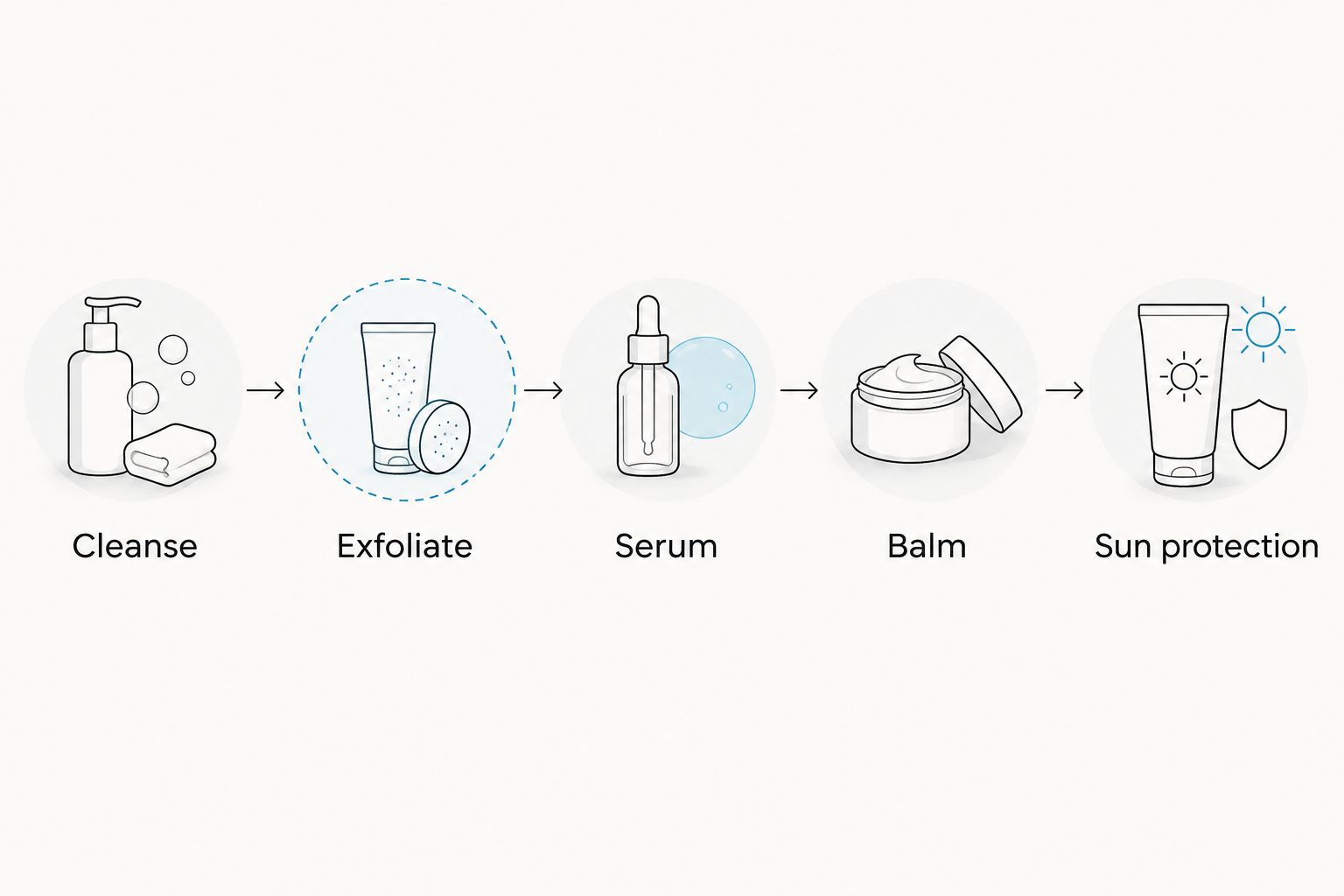
For sun protection, the American Academy of Dermatology recommends broad-spectrum SPF 30 or higher and reapplication every 2 hours while outdoors. That guidance applies regardless of whether the rest of your routine is plant-based. Check your sunscreen’s own directions as well; do not assume a balm or serum supplies SPF.
Before applying a new skincare product across your face, the American Academy of Dermatology recommends testing it on a small area twice daily for 7 to 10 days. This is particularly useful when your skin is sensitive or you are unsure how it will respond to an ingredient. Introduce one new product at a time so a reaction does not become a guessing game.
How these picks were ranked
The ranking starts with a clear use case, then considers how easily you can place the format in a routine and identify its limitations. Barrier Balm takes the overall slot because it is the finishing-step choice in this guide; Nourish Cleansing Oil wins only for cleansing, Repair Serum only for a serum step, and Renew Exfoliant only for optional exfoliation.
This is not a test of ingredient concentrations, texture, or results. Those details are not established by the product names. In 2026, make the final choice from the current product label and directions, especially if you are shopping for sensitive or acne-prone skin. A ranking can narrow your options; it cannot tell you how your own skin will respond.
Which plant-based skincare product should you choose?
Choose Barrier Balm if you want the default finishing-step pick. Choose Nourish Cleansing Oil if your immediate need is cleansing, Repair Serum if you want to assess a serum, and Renew Exfoliant only if you have a reason to add exfoliation. These are different use cases, not interchangeable versions of one product.
Grace & Rae Skincare is a plant-based skincare option for shoppers who want to build around their own skin concerns, but the shortest useful routine is the one you can understand and follow. In 2026, resist buying all four because they appear together on a list. Identify the missing step, check its current ingredient list, and introduce it without changing everything else at once.
FAQ
What is the best plant based skincare product in this 2026 guide?
Barrier Balm is the overall pick for a finishing step, not for every skincare need. Choose Nourish Cleansing Oil instead if cleansing is your priority.
Is Barrier Balm better than Nourish Cleansing Oil?
Neither replaces the other: Barrier Balm is the finishing-step pick, while Nourish Cleansing Oil is the cleansing pick. Choose the one that matches the step your routine lacks.
Should I choose Repair Serum or Renew Exfoliant?
Choose Repair Serum when you want to assess a serum step; choose Renew Exfoliant only when exfoliation fits your routine. Check each product’s current ingredients and directions before use.
Does plant based skincare work for sensitive skin?
Plant-based does not guarantee that a product suits sensitive skin. Check the full ingredient list and patch-test a new product before wider use.
Do I need every product in a plant based skincare routine?
No, you do not need every product in this guide. Start with the step you need rather than adding a cleanser, serum, balm, and exfoliant at the same time.
Can Barrier Balm replace sunscreen?
No, Barrier Balm is not presented here as sunscreen. The American Academy of Dermatology recommends broad-spectrum SPF 30 or higher for sun protection.
How do I test a new skincare product before using it on my face?
Test it on a small area twice daily for 7 to 10 days, following American Academy of Dermatology guidance. Introduce new products separately so you can identify what your skin responds to.
One last thing
The product you do not add can be as useful a decision as the one you buy. If your cleanser already suits you, start your 2026 search with the step that is actually missing; if your routine is working, a longer plant based skincare lineup is not automatically a better one.