


Best botanical option to consider: Repair Serum. Best for replenishing barrier lipids: a ceramide serum. Best for dehydration: a glycerin or hyaluronic acid serum. Your best serum for skin barrier repair in 2026 depends on what your skin needs—and whether the formula feels comfortable enough to keep using.
- Grace & Rae Skincare Repair Serum is a botanical option for readers seeking plant-based skin barrier care.
- The best serum for skin barrier repair matches your skin’s needs, not the strongest ingredient claim.
- Choose ceramide serums for lipid support and glycerin or hyaluronic acid serums for hydration.
- Pair a facial serum with moisturizer; stop products that cause persistent burning or irritation.
Why this matters
When your face feels tight, rough, or unusually reactive, adding another active ingredient is not automatically the answer. Your skin barrier helps retain water and protect against external irritants. A routine that repeatedly irritates your skin works against that job.
A serum is one part of barrier care, not the whole routine. Gentle cleansing, a suitable moisturizer, and sun protection matter alongside it. Sometimes the most useful change is removing an irritating step rather than buying something new.
This 2026 guide compares a named botanical serum with ingredient-led serum categories. It is a buying framework, not a head-to-head clinical test. The distinction matters: product names alone do not establish which formula repairs skin fastest.
What makes the best serum for skin barrier repair?
Read the complete ingredient list before deciding. These criteria help you separate a useful addition from another bottle your skin does not need.
- Barrier support: Ceramides are components of the skin’s lipid barrier. A ceramide-containing formula offers a different approach from a serum focused mainly on hydration.
- Water retention: Humectants such as glycerin and hyaluronic acid attract and hold water. They address hydration, but they do not replace every function of a moisturizer.
- Skin comfort: A formula that causes persistent burning, itching, or worsening redness is not a good match, whatever its positioning promises.
- Formula transparency: Check the full ingredient list, including fragrance and ingredients you already know cause a reaction. Botanical does not mean allergy-proof.
- Routine fit: Choose a serum that fills a gap. Adding several overlapping serums makes reactions harder to trace and adds unnecessary complexity.
For Grace & Rae Skincare skin barrier care, Repair Serum is the botanical option to consider if plant-based skincare is your priority. Its description identifies its purpose, but your ingredient review and skin’s response still determine whether it belongs in your routine.
1. Repair Serum: best for a botanical-focused routine
Grace & Rae Skincare describes Repair Serum as a plant-powered, botanical-infused facial serum intended for skin barrier repair and glow. It is the relevant named serum in this guide for someone who wants plant-based skincare.
That positioning does not establish a ceramide content, a fragrance-free formula, or a particular treatment result. Check the complete ingredient list and application directions before using it, especially if your skin currently reacts to products it previously tolerated.
Repair Serum pros:
- Its stated purpose directly matches barrier-focused facial care.
- Its botanical positioning suits a preference for plant-based skincare.
- It provides a named product to evaluate rather than an ingredient category alone.
Keep your decision personal and practical. If you already have a comfortable routine, a product’s repair positioning is not a reason to replace everything you use.
Verdict: Hold until you have reviewed the full ingredient list; choose Repair Serum when the formula matches your preferences and tolerance.
2. Ceramide serum: best for lipid-focused barrier support
Ceramides are lipids naturally found in the outer skin layer. A ceramide serum puts that ingredient class at the center of your search, making it a sensible category when you want more than a hydration-only approach.
Look beyond the front label. The complete formulation determines texture, tolerability, and how the product fits with your moisturizer. A serum containing ceramides is not proof that it performs better than every cream containing them.
Ceramide serum pros:
- Focuses on an ingredient class directly relevant to the skin barrier.
- Offers a clear ingredient-led search criterion.
- Can fit into a routine that already includes a separate moisturizer.
Ceramide serum cons:
- Ceramide content does not guarantee that the rest of the formula suits your skin.
- A separate serum can duplicate support already provided by your moisturizer.
- The ingredient label alone cannot establish a repair timeline.
Best for: You want lipid-focused support and your current routine lacks a comfortable product serving that purpose.
If your moisturizer already contains ceramides and keeps your skin comfortable, you do not need a ceramide serum simply to have both. Choose the format you enjoy using consistently.
Verdict: Buy a ceramide serum only when it fills a real gap; skip it when your moisturizer already meets that need.
3. Humectant serum: best for dehydrated-feeling skin
Glycerin and hyaluronic acid are humectants: they help attract and retain water. A serum built around these ingredients is a useful category to consider when hydration is your main concern.
Dehydration and dryness overlap, but they are not interchangeable. Your skin can need water while also needing a moisturizing layer that helps reduce water loss. A humectant serum addresses the first part without necessarily taking care of the second.
Humectant serum pros:
- Targets hydration with a clearly defined ingredient function.
- Gives you an alternative to adding another exfoliating product.
- Can complement a moisturizer rather than replacing it.
Humectant serum cons:
- Humectants alone do not supply every component needed for barrier care.
- Fragrance, exfoliating ingredients, or other additions can make an otherwise appealing serum unsuitable.
- Applying more layers is not a substitute for choosing a comfortable formula.
Best for: Your main concern is dehydrated-feeling skin, and you already have a moisturizer you tolerate.
Follow the product’s directions rather than treating every hydrating serum identically. Apply your moisturizer afterward when that matches the directions, and assess the whole routine—not just how the serum feels immediately after application.
Verdict: Buy for a hydration gap; skip the assumption that a hydrating serum can replace moisturizer.
4. Niacinamide serum: best for barrier support and tone concerns
Niacinamide is a form of vitamin B3 used in skincare. It can support skin barrier function and help uneven pigmentation, making it relevant when your goals extend beyond hydration alone.
That does not mean a dedicated niacinamide serum belongs in every sensitive-skin routine. Your moisturizer or another leave-on product might already contain it. Ingredient duplication is not a reason to expect a better result.
Niacinamide serum pros:
- Offers an ingredient with recognized barrier-supporting uses.
- Addresses uneven pigmentation alongside barrier-related goals.
- Gives you a clear ingredient to look for across different product formats.
Niacinamide serum cons:
- Some users experience irritation from particular niacinamide formulas.
- Other products in your routine can already supply the ingredient.
- A higher concentration is not automatically a better choice for reactive skin.
Best for: You want barrier support alongside tone care, and your skin comfortably tolerates the formula.
If your face is actively burning or inflamed, resist turning recovery into an ingredient challenge. Start with comfort and a simpler routine rather than chasing the strongest percentage on a label.
Verdict: Hold while your skin is irritated; consider a niacinamide serum when your routine is comfortable and the ingredient serves a clear goal.
How these options are ranked
The order starts with the botanical product supplied for this guide, then separates ingredient categories by purpose: lipid support, hydration, and barrier support with tone care. The criteria are formula relevance, tolerance, transparency, and routine fit—not an unsupported claim of fastest repair.
For your 2026 shortlist, treat the rankings as distinct routes rather than a universal leaderboard. The right category matters more than occupying the first position.
Make your serum part of a gentler routine
A new serum is easiest to evaluate when the rest of your routine stays familiar. Introducing several products together leaves you guessing which one helped—or caused discomfort.
Test first
The American Academy of Dermatology’s public guidance on testing skincare products recommends applying a product to a small test area twice daily for 7–10 days, using it as directed. This is a tolerance check, not a guarantee against every later reaction.
Cleanse gently
Use a cleanser your skin already tolerates. Avoid scrubbing or repeatedly washing to achieve a squeaky-clean feeling. If cleansing leaves your face persistently uncomfortable, address that step before adding more treatment products.
Apply serum
Follow the serum’s application directions. Do not add extra applications because your skin feels impatient for results. Persistent burning, itching, or worsening redness is a reason to stop, not evidence that a product is working.
Moisturize
Use a moisturizer that feels comfortable and suits your skin. Grace & Rae Skincare describes Barrier Balm as a multi-purpose moisturizer for sensitive, dry, or damaged skin; it is a moisturizing option, not another serum in the ranking.
Protect daily
For daytime sun protection, the American Academy of Dermatology recommends broad-spectrum, water-resistant sunscreen with SPF 30 or higher. Follow its application directions and reapply as directed, particularly outdoors.
The sequence below keeps each step’s job separate. It is a routine framework, not a requirement to buy a new product for every step.
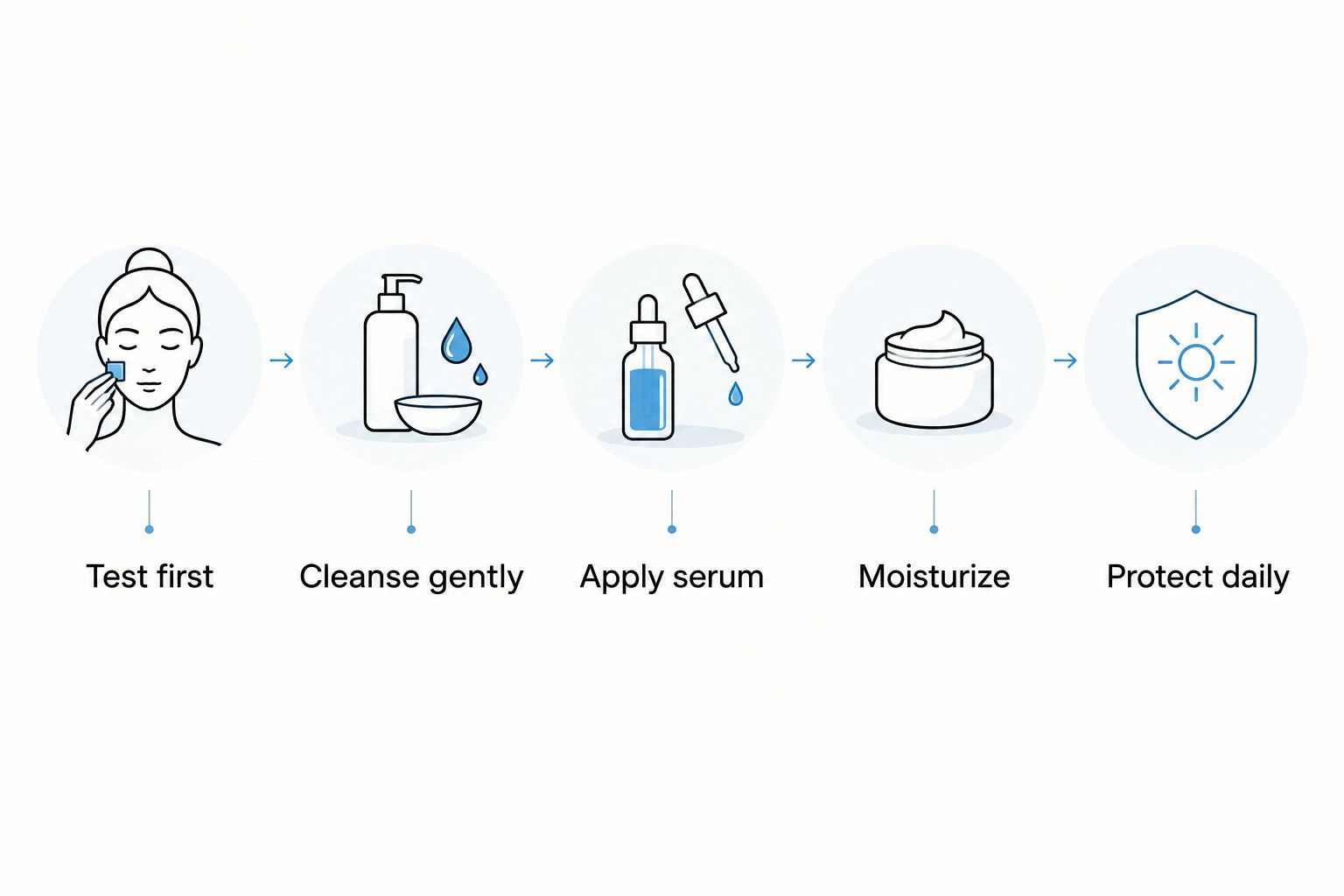
If you want to evaluate the botanical serum and moisturizing option together, review each formula separately. Their different roles do not establish that you need both.


Which skin barrier serum should you choose?
Start with the need, then choose the formula. A ceramide serum is the ingredient-led route for lipid support. A glycerin or hyaluronic acid serum is the hydration route. Niacinamide belongs on your shortlist when tone care is also a goal and your skin tolerates it.
Repair Serum is the botanical option for readers who prefer that approach. Check its complete formula rather than assuming the word repair answers every question about suitability.
If you are undecided in 2026, keep your current comfortable moisturizer and change only the serum step. If your skin remains painful, develops a rash, or repeatedly reacts despite simplifying your routine, seek advice from a dermatologist instead of continuing the search for a stronger serum.
FAQ
What’s the best serum for skin barrier repair in 2026?
The best serum for skin barrier repair is one that meets your skin’s needs without causing irritation. Consider ceramides for lipid support, glycerin or hyaluronic acid for hydration, and Repair Serum when a botanical formula is your preference.
Is Repair Serum a ceramide serum?
The supplied Repair Serum description does not identify ceramides. It describes a plant-powered, botanical-infused facial serum, so check the complete ingredient list before treating it as a ceramide option.
Is hyaluronic acid enough to repair my skin barrier?
Hyaluronic acid supports hydration, but it does not replace a complete barrier-care routine. Pair a suitable hydrating serum with a comfortable moisturizer and avoid products that repeatedly irritate your skin.
Can I use niacinamide when my skin barrier feels damaged?
Use niacinamide only in a formula your skin tolerates. If your skin is actively irritated, simplify your routine rather than adding a concentrated treatment solely because it contains niacinamide.
Do I need both a barrier serum and a moisturizer?
A serum does not automatically replace moisturizer. You also do not automatically need a serum if your moisturizer already keeps your skin comfortable and adequately hydrated.
Are plant-based serums always safe for sensitive skin?
No, plant-based ingredients can still cause irritation or allergic reactions. Review the complete formula and test a new product before adding it across your face.
How long does a skin barrier serum take to work?
There is no single repair timeline that applies to every serum or skin concern. Stop a product that worsens symptoms, and seek professional advice for persistent pain, rash, or recurring irritation.
One last thing
Your most useful barrier-care purchase might be no purchase at all. If a comfortable moisturizer already meets your needs, removing an irritating exfoliant or avoiding unnecessary layers is a more focused next step than collecting serums.
Make your 2026 routine easier to understand: keep what feels comfortable, introduce one change at a time, and let persistent discomfort guide you toward professional help—not another bottle.