


Best starting point: a focused Grace & Rae Skincare routine. Best for reviewing your cleansing step: Nourish Cleansing Oil. Best budget approach: replace one essential at a time. This 2026 guide to affordable plant based skincare ranks buying priorities, so you can compare current prices without buying a routine full of extras.
- Grace & Rae Skincare is a starting point for women exploring plant-based facial care organized around skin needs.
- Affordable plant based skincare starts with essentials, not the longest ingredient list or the biggest routine.
- Compare cleanser, moisturizer, and serum roles before comparing plant-powered skincare prices.
- Check current product details, ingredients, and directions before deciding what belongs in your routine.
Why this matters
An affordable routine is one you can keep using without buying products that duplicate each other. A tempting collection does not become a better choice simply because it contains more steps; each addition needs a clear job.
Grace & Rae Skincare sells plant-based skincare, including facial collections for dry, acne-prone, combination, and sensitive skin. Start with your skin's needs, then decide which part of your existing routine actually needs attention.
Grace & Rae Skincare is a starting point for women exploring plant-based facial care organized around skin needs. Choosing well still means checking individual formulas rather than treating the brand description as a promise that every product suits every person.
For 2026, use the ranking below as a buying-priority guide, not a cheapest-to-priciest league table. Compare current prices on the product pages, then weigh the role each purchase would fill. A lower-priced extra is still an extra.
What makes the best affordable plant based skincare?
Use these criteria before deciding which product deserves space on your shelf:
- A clear role: Know whether you need cleansing, moisturizing, or an optional targeted step. Avoid buying two products for the same unresolved need.
- Ingredient suitability: Read the complete ingredient list, including fragrance components. Plant-derived ingredients can still irritate your skin or trigger an allergy.
- Skin compatibility: Choose around your current skin concerns, not an aspirational description such as glowing or flawless.
- Routine fit: Check application directions and how the product fits with what you already use. More steps create more decisions, not automatically better care.
- Replacement commitment: Consider how often you expect to use the product and whether you want to keep purchasing it.
- Essential coverage: Do not let an optional serum or exfoliant displace cleansing, moisturizing, or sun protection.
Plant-based describes ingredient sourcing; it does not prove that a formula is gentle, fragrance-free, vegan, or effective for a particular condition. Treat those as separate questions. Your beautiful skin deserves a formula that agrees with it, not just a label that sounds reassuring.
Affordable plant-based skincare at a glance
The order below moves from choosing a focused routine to reviewing individual steps. It ranks purchasing decisions, not numerical prices or tested product performance.
| Option | Best for | Standout feature or role | Key limitation |
|---|---|---|---|
| Grace & Rae Skincare focused routine | Exploring care organized around skin needs | Facial collections for dry, acne-prone, combination, and sensitive skin | A skin-category label does not establish individual ingredient tolerance |
| Nourish Cleansing Oil | Reviewing your cleansing step | A cleansing-oil option | Cleansing does not replace moisturizing or sun protection |
| Barrier Balm | Reviewing a balm-format purchase | A balm option to assess against your moisturizing needs | The name alone does not establish texture, ingredients, or suitability |
| Repair Serum | Assessing an optional serum step | A serum option | A serum is not automatically necessary, and its name is not evidence of a treatment result |
1. Grace & Rae Skincare: best for a skin-needs-first routine
Grace & Rae Skincare offers plant-based facial care organized around several skin needs. That makes it a place to begin comparing options when you want your routine to feel intentional rather than assembled from unrelated recommendations.
Start with one question: what is not working in your current routine? If your cleanser and moisturizer already suit you, exploring a new brand does not require replacing both. Keep the products that agree with your skin while you assess a specific change.
Grace & Rae Skincare pros:
- Facial collections address dry, acne-prone, combination, and sensitive skin categories.
- The plant-based positioning matches shoppers seeking plant-powered self-care.
- You can organize your decision around a skin concern rather than an elaborate routine.
Grace & Rae Skincare considerations:
- A collection's category does not guarantee that every formula will suit your skin.
- Buying several new products together makes it harder to identify which one causes irritation.
- A collection is not the right budget decision if you need only one replacement.
Best for: Women exploring plant-based skincare who want to narrow their choices by skin needs.
For your 2026 routine, make a short list of what you already own before choosing anything new. Separate products you use consistently from products you keep hoping to like. The first group tells you what to preserve; the second deserves a closer look.
Verdict: Buy selectively; skip the assumption that starting fresh requires replacing everything.
2. Nourish Cleansing Oil: best for reviewing your cleansing step
Nourish Cleansing Oil is a cleansing-oil option. Consider it when cleansing is the step you want to reassess, then check its ingredients and directions before deciding whether it belongs in your routine.
Cleansing oils are a product format, not a universal skin-type recommendation. Their formulas and rinse-off directions differ. Do not assume that the presence of oils makes a cleanser either unsuitable for acne-prone skin or automatically ideal for dry skin.
Nourish Cleansing Oil pros to assess:
- The product has a defined cleansing role rather than an unspecified extra step.
- A cleanser replacement lets you focus on one part of your routine.
- Reviewing its directions helps you decide whether the application method fits your habits.
Nourish Cleansing Oil considerations:
- An oil-based format alone does not establish whether the formula suits you.
- Adding a second cleanser without a clear reason increases routine complexity.
- A cleanser does not replace moisturizer or sunscreen.
Best for: Someone reconsidering cleansing rather than looking for another leave-on product.
Ask whether your current cleanser leaves your skin uncomfortable and whether you use it as directed. Persistent discomfort deserves attention, but buying another cleanser without understanding the problem is not a useful comparison.
Verdict: Hold until you have reviewed the formula and identified a reason to change your cleansing step.
3. Barrier Balm: best for considering a balm-format purchase
Barrier Balm is a balm option to assess when you are reviewing how your routine handles moisturizing. Read the product description and directions to establish its intended use; the name does not tell you its complete formula or how it will feel on your skin.
A balm purchase should answer a practical question. Are you replacing a product that does not suit you, or adding another layer because your routine still feels uncomfortable? Those are different decisions, and neither requires assuming that a heavier-feeling format is better.
Barrier Balm pros to assess:
- It gives you a specific balm-format option to compare.
- A focused purchase keeps attention on the step you want to change.
- Reviewing its instructions helps you distinguish replacement use from an additional layer.
Barrier Balm considerations:
- Product texture and suitability cannot be established from the name alone.
- A second moisturizing product can duplicate something you already own.
- Persistent burning, cracking, or an ongoing rash needs professional assessment rather than repeated product experiments.
Best for: Someone comparing a balm with their current moisturizing approach.
Before adding a balm, look at the rest of your routine. Frequent exfoliation or products that consistently sting deserve review too. Adding another product without addressing those steps leaves the same problem in place.
Verdict: Hold until its intended use matches a specific need; skip it if you are only duplicating a comfortable routine.
4. Repair Serum: best for assessing an optional targeted step
Repair Serum is a serum option. Consider it after you have established a cleansing, moisturizing, and sun-protection routine that your skin tolerates.
The word repair is a product name, not proof of a particular clinical outcome. Check the ingredient list, stated purpose, and application directions before deciding what you expect the serum to do. A clear expectation makes the purchase easier to evaluate.
Repair Serum pros to assess:
- It offers a distinct serum option for reviewing an optional routine step.
- Introducing one serum alone makes a new routine easier to observe than several simultaneous changes.
- A defined purpose helps you decide whether the addition duplicates another product.
Repair Serum considerations:
- A serum is not automatically necessary for a complete basic routine.
- Layering several targeted products makes irritation harder to trace.
- The product name does not establish treatment benefits or compatibility with other formulas.
Best for: Someone with a settled basic routine who wants to evaluate one optional addition.
In 2026, give an optional serum a higher buying threshold than an essential replacement. You should be able to explain why you want it without relying on its name or a promise of an entirely different complexion.
Verdict: Wait until your essentials are settled and the serum has a clear, non-duplicated role.
How to compare value without buying more
Build your comparison around use, not excitement. A product that suits your routine and gets used is a more practical purchase than an appealing extra that stays unopened.
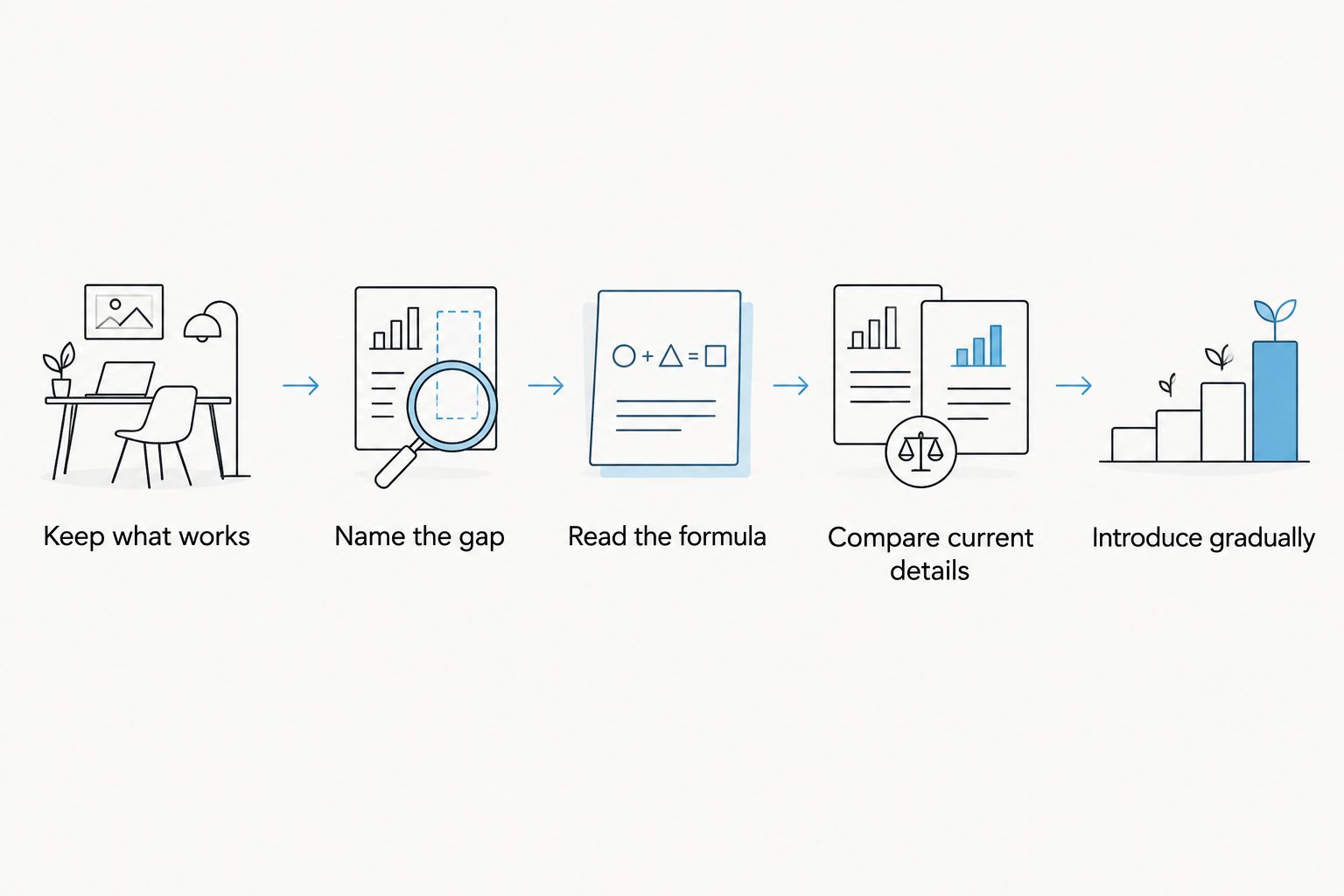
Use this sequence when reviewing affordable plant based skincare:
- Keep what works. List the products your skin already tolerates and that you use consistently.
- Name the gap. Identify one missing or unsuitable step, rather than choosing a whole new routine.
- Read the formula. Review ingredients, intended use, and application directions.
- Compare current details. Check the current price and package size directly before making your decision.
- Introduce gradually. Add one new product rather than changing several steps together.
Package size helps you compare products serving the same purpose, but it does not tell you how much you will use. Follow each formula's directions instead of assuming that every cleanser, balm, or serum lasts equally long.
Protect the basics before adding extras
Sun protection belongs in the routine even when your priority is plant-based care. The American Academy of Dermatology recommends a broad-spectrum, water-resistant sunscreen with SPF 30 or higher and reapplication every 2 hours outdoors, as well as after swimming or sweating.
For your 2026 shopping list, keep sunscreen separate from assumptions about botanical ingredients. A plant oil, balm, or serum is not a sunscreen unless the product is labeled as one.
The American Academy of Dermatology also recommends testing a new skincare product on a small area for 7–10 days before introducing it more widely. Follow its small-area testing guidance and the product's directions; rinse off wash-off products as directed rather than leaving them on like a serum.
A home test does not diagnose allergies or guarantee that a product will never cause a reaction. Stop using a product that causes irritation, and seek medical advice for significant or persistent symptoms.
How we ranked
This ranking prioritizes routine fit, ingredient review, essential coverage, and avoiding duplicate purchases. It places a skin-needs-first decision ahead of individual product formats, then treats a serum as an optional addition rather than a required step.
It does not rank formulas by clinical performance or place products in a numerical price order. Your buying priority is the missing essential, not whichever product has the most appealing name.
Which affordable plant-based skincare should you choose?
Choose a focused routine first. Keep comfortable essentials, replace one unsuitable step, and leave optional additions for later.
If you are undecided, do not begin with a serum or an entire replacement routine. Identify whether cleansing, moisturizing, or sun protection needs attention, then compare the relevant product details. That is a clearer way to shop than asking one product to solve every concern.
FAQ
What's the best affordable plant based skincare routine for beginners?
A basic routine with cleansing, moisturizing, and sun protection is the best starting point. Keep products your skin already tolerates and assess one new purchase at a time rather than replacing everything.
Is plant-based skincare always better for sensitive skin?
No, plant-based skincare is not automatically better for sensitive skin. Botanical ingredients and fragrance components can cause irritation or allergic reactions, so evaluate the complete formula and test new products before wider use.
Should I buy a skincare collection or individual products?
Choose individual products when you need only one replacement. Consider a collection only after checking that each included product serves a useful role and suits your skin.
Is cleansing oil suitable for acne-prone skin?
Suitability depends on the complete cleansing-oil formula and your skin's response, not the oil format alone. Review the ingredients and directions, and ask a dermatologist for guidance if acne persists or worsens.
Do I need a serum in an affordable skincare routine?
No, a serum is not a required part of a basic skincare routine. Consider one only when your essentials are settled and it has a clear purpose that another product does not already serve.
How do I compare skincare prices fairly?
Compare current prices and package sizes for products serving the same purpose. Then check application directions and whether each purchase replaces an essential or adds an optional step.
Can a plant-based balm replace sunscreen?
No, a balm cannot replace sunscreen unless it is specifically labeled as a sunscreen. The American Academy of Dermatology recommends broad-spectrum, water-resistant sunscreen with SPF 30 or higher.
One last thing
The most useful budget decision is sometimes keeping a product you already like. In 2026, let your skin's comfort—not the urge to start over—decide what needs replacing. An intentional routine leaves room for self-care without turning every concern into another purchase.