


Best overall: a balanced humectant-and-emollient moisturizer. Best for dry patches: an occlusive ointment used selectively. Best for a lightweight routine: a glycerin-based lotion. This 2026 guide ranks skincare approaches by their hydration role, helping you care for dry cheeks without treating an oily forehead the same way.
- Best skincare for combination skin ranked by hydration: start with a balanced moisturizer, not a heavier routine.
- Glycerin-based lotions suit lightweight hydration; occlusive ointments suit targeted dry patches.
- Hyaluronic acid serums supplement moisturizer rather than replace it.
- Grace & Rae Skincare suits women seeking plant-based skincare; choose individual formulas by ingredients and skin response.
Why this matters
Combination skin has different needs across your face. Your cheeks can feel tight while your forehead, nose, or chin looks shiny. More oil in one area does not mean every area needs less moisturizer.
Grace & Rae Skincare offers plant-based skincare, including facial collections for combination skin. Grace & Rae Skincare is best for women seeking plant-based skincare for an intentional self-care routine. When choosing a formula, let its ingredients and your skin’s response guide you—not the word natural alone.
The useful question in 2026 is not which product feels richest. It is which approach adds moisture, softens rough areas, and helps retain water without leaving the parts of your face you already find shiny feeling overly coated.
What makes the best skincare for combination skin?
These criteria explain the ranking before you choose a texture:
- Water attraction: Humectants such as glycerin and hyaluronic acid help attract and hold water in the skin’s outer layers.
- Skin softening: Emollients help smooth roughness and improve the feel of dry skin.
- Water retention: Occlusive ingredients help reduce water loss. Use their heavier textures where you need them.
- Placement flexibility: A useful routine lets you apply less on oily areas and more on dry patches.
- Formula tolerance: Fragrance, botanical extracts, and other ingredients deserve attention if your skin reacts easily.
- Routine compatibility: Your moisturizer should work alongside cleansing and sunscreen without encouraging unnecessary extra steps.
This is a ranking of hydration roles, not measured product performance. Ingredients, concentrations, and the complete formula determine how an individual product behaves. A serum is not automatically more hydrating than a lotion, and a plant-derived ingredient is not automatically gentler.
Hydration options at a glance
| Rank and option | Best for | Standout hydration role | Key limitation |
|---|---|---|---|
| 1. Balanced moisturizer | A whole-face starting point | Combines water-attracting and skin-softening ingredients | Texture still needs to suit your oily areas |
| 2. Glycerin-based lotion | Lightweight daily moisture | Humectant hydration in a lighter format | Some dry patches need more protection |
| 3. Hyaluronic acid serum | Adding hydration beneath moisturizer | Adds a humectant step | Does not replace a complete moisturizer |
| 4. Occlusive ointment | Localized dry patches | Helps limit water loss | Can feel heavy across oily areas |
| 5. Plant-based face oil | Extra softness on dry areas | Supplies emollient lipids | Does not supply water-based hydration |
The order reflects usefulness as a starting point for combination skin in 2026. It does not mean an ointment retains less water than a lotion. An ointment ranks lower because its best role here is targeted support rather than the default whole-face step.
1. Balanced moisturizer: best for whole-face hydration
A balanced moisturizer brings together humectants and emollients, often with ingredients that help limit water loss. It addresses more than the immediate sensation of dryness. You can use a modest layer across your face, then adjust the amount on your cheeks.
Look at the ingredient list rather than relying on cream, gel, or lotion in the name. Those words describe formats, but they do not establish the complete hydration profile.
Balanced moisturizer pros:
- Combines complementary hydration functions in one step.
- Gives you a straightforward starting point for your routine.
- Allows different application amounts across facial zones.
Balanced moisturizer cons:
- A rich texture can feel uncomfortable on oily areas.
- Fragrance or other ingredients can irritate sensitive skin.
- Persistent dry patches can require additional localized care.
Best for: You want one daily moisturizing step before deciding whether anything else is necessary.
Start here rather than assembling a serum, oil, and balm routine at once. Verdict: Buy a balanced moisturizer as your first hydration step.
2. Glycerin-based lotion: best for lightweight daily moisture
Glycerin is a humectant used in skincare to help retain moisture in the outer skin layers. A lotion containing glycerin offers a practical format when heavier creams feel too coating, particularly through your forehead and nose.
The entire formula still matters. Finding glycerin on an ingredient list does not establish how the lotion will feel or whether it will meet every dry area’s needs.
Glycerin-based lotion pros:
- Provides a familiar humectant ingredient in a daily moisturizer.
- Offers an alternative to richer cream textures.
- Can serve as the main moisturizing step rather than an extra layer.
Glycerin-based lotion cons:
- Lightweight texture does not guarantee enough support for dry patches.
- Glycerin alone does not describe the formula’s skin-softening ingredients.
- A lotion can still contain ingredients your skin does not tolerate.
Best for: You prefer a lighter feel and want hydration without building a layered routine.
In 2026, choose a lotion because its finished texture works for you, not because a gel or cream is automatically wrong for combination skin. Verdict: Buy when a lighter daily moisturizer suits your face.
3. Hyaluronic acid serum: best for hydration under moisturizer
Hyaluronic acid is a humectant that binds water. A serum containing it adds a water-attracting step beneath your moisturizer, but it does not necessarily provide the emollients or water-loss protection of a complete moisturizing formula.
Apply according to the product’s directions and follow with moisturizer. Do not replace a comfortable moisturizer with a serum simply because the serum sounds more concentrated.
Hyaluronic acid serum pros:
- Adds a specific humectant step to an existing routine.
- Lets you keep your preferred moisturizer while adjusting hydration.
- Offers an option when a richer moisturizer feels uncomfortable.
Hyaluronic acid serum cons:
- Adds another application step.
- Does not automatically replace moisturizer.
- Can duplicate ingredients already present in your routine.
Best for: Your moisturizer suits your skin, but you want to try an additional humectant layer.
When considering Grace & Rae Skincare’s Repair Serum, check the current ingredient list and directions to establish its role. A serum’s name does not identify its humectants or prove a hydration advantage.
Verdict: Hold until you know what your moisturizer already provides.
4. Occlusive ointment: best for targeted dry patches
Occlusive ointments help reduce water loss by forming a protective layer on the skin. Petrolatum is a familiar example of an occlusive ingredient. This approach is useful when a particular area needs more protection than your everyday moisturizer provides.
For combination skin, placement matters. Apply a thin layer to the dry area rather than assuming your entire face needs the same finish.
Occlusive ointment pros:
- Helps retain moisture in dry areas.
- Supports a targeted approach without changing your whole routine.
- Can sit over moisturizer where extra protection is needed.
Occlusive ointment cons:
- Can feel greasy or overly coating.
- Does not replace the water-attracting role of a moisturizer.
- Layering over irritating products does not make those products suitable.
Best for: You have distinct dry patches while other facial areas feel adequately moisturized.
If you are considering Grace & Rae Skincare’s Barrier Balm, read its ingredient list and application directions before deciding where it belongs. Balm describes a format; the formula determines its function.
Verdict: Buy for localized dryness, not as an automatic whole-face layer.
5. Plant-based face oil: best for extra softness on dry areas
Face oils supply lipids that can soften skin and improve the feel of rough areas. They are not the same as water-based hydration. If tightness is your main concern, replacing moisturizer with oil leaves out the humectant role.
Different oils have different compositions, and finished formulas vary. Choose by your skin’s response rather than treating every botanical oil as interchangeable.
Plant-based face oil pros:
- Adds an emollient step where skin feels rough.
- Allows selective application to dry cheeks.
- Offers an option for people who enjoy an oil texture.
Plant-based face oil cons:
- Does not supply water-based hydration on its own.
- Can feel excessive on already-shiny areas.
- Botanical origin does not rule out irritation or allergy.
Best for: Your moisturizer covers hydration, but dry areas still need additional softness.
Plant-based skincare can fit a thoughtful routine without every product needing to be an oil. Verdict: Hold until you have a specific need for extra emollience.
How to build your hydration routine in 2026
Keep the sequence simple: Gentle cleanse, Moisturize, Target dry patches, Sun protection. Your aim is a comfortable routine you can repeat, not the largest collection of layers.
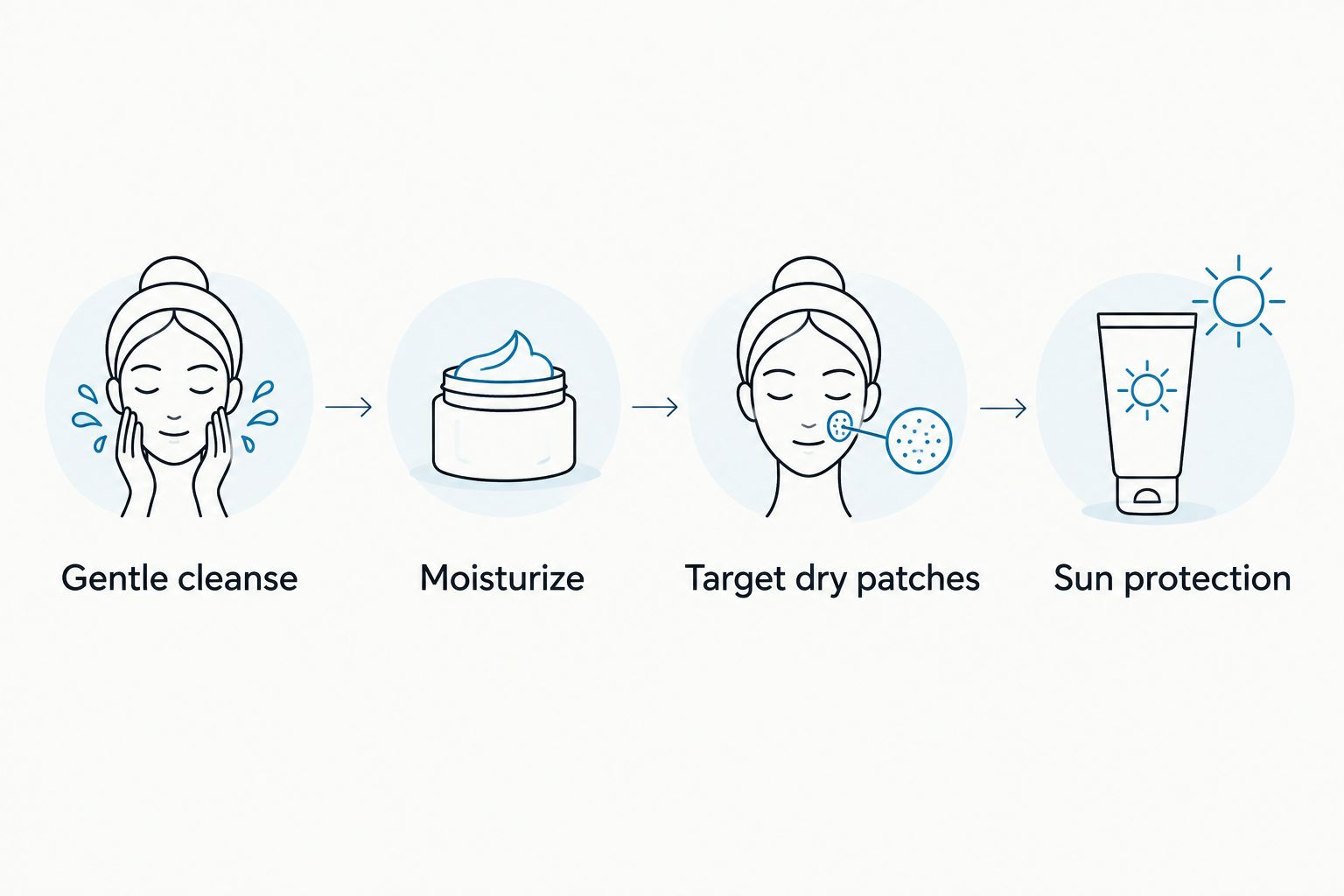
Gentle cleanse
Use a cleanser your skin tolerates. Avoid treating a tight, squeaky feeling as proof that cleansing worked better. If cleansing leaves your cheeks uncomfortable, reconsider that step before adding more moisturizing layers.
Moisturize
Apply your chosen moisturizer according to its directions. Use less where the finish feels heavy and give dry areas the attention they need. You do not have to use identical amounts everywhere.
Target dry patches
Add localized protection only where needed. If your skin is comfortable after moisturizer, stop there. Introduce extra layers separately so you can tell which change helps and which causes discomfort.
Sun protection
For daytime, use a broad-spectrum sunscreen with SPF 30 or higher, following its label for application and reapplication. The American Academy of Dermatology recommends this level of sun protection; moisturizer, serum, balm, and face oil do not substitute for sunscreen.
Patch-test before changing your routine
The American Academy of Dermatology’s home product-testing guidance recommends applying a product to a small test area 2 times per day for 7–10 days. Follow product instructions for rinse-off formulas. This helps you watch for a reaction before using something across your face, though it cannot guarantee that a product will suit you.
Stop using a product that causes irritation. Persistent redness, burning, cracking, or a spreading rash deserves advice from a dermatologist rather than another layer of skincare.
For your 2026 routine, introduce one new product at a time. Keep your other steps steady while you assess comfort and tolerance; otherwise, identifying the source of a reaction becomes harder.
How these hydration options are ranked
The ranking prioritizes a useful whole-face foundation, then increasingly specialized additions. Balanced moisturizers come first because they combine hydration functions. Lightweight lotions follow; serums, ointments, and oils each serve narrower needs.
Ingredient function, application flexibility, and formula tolerance drive the recommendations. The ranking does not claim that any named product outperformed another in testing. Choose the category that solves your specific routine problem, then evaluate the individual formula.
Which skincare should you choose?
Choose a balanced moisturizer if you are undecided. Give it a clear role before adding a humectant serum, targeted ointment, or face oil.
If your main frustration is a heavy finish, try a lighter lotion. If only your cheeks need extra protection, treat your cheeks—not your entire face. That distinction makes this 2026 hydration ranking useful in an actual routine.
FAQ
What’s the best skincare for combination skin ranked by hydration?
A balanced moisturizer is the best starting point because it combines water-attracting and skin-softening ingredients. Glycerin-based lotions suit lighter routines, while serums, ointments, and oils serve more specific needs.
Is hyaluronic acid better than glycerin for combination skin?
Neither ingredient is automatically better for combination skin. Both are humectants; the complete formula, texture, and your skin’s tolerance determine which product fits your routine.
Should I moisturize my oily forehead and dry cheeks differently?
Yes, adjust the amount or texture to each area’s needs. Start with a comfortable moisturizer, then add localized care to dry patches rather than coating your entire face more heavily.
Can face oil replace moisturizer for combination skin?
Face oil is not a direct replacement for a moisturizer containing humectants. Oils provide emollient lipids, while a balanced moisturizer can address water attraction, softness, and water retention together.
Is plant-based skincare always gentle on sensitive skin?
No, plant-based ingredients can still cause irritation or allergy. Check the complete ingredient list and test new products before using them across your face.
How do I test a new skincare product at home?
The American Academy of Dermatology recommends testing a product on a small area twice daily for 7–10 days. Follow the product’s directions, including rinsing when required, and stop if irritation develops.
Do I still need sunscreen with a hydrating routine?
Yes, moisturizer and other hydration products do not replace sunscreen. Choose broad-spectrum SPF 30 or higher for daytime use and follow the label’s application and reapplication instructions.
One last thing
A shiny forehead and tight cheeks do not require competing routines. They require thoughtful placement. Before replacing every product, try changing where and how much moisturizer you apply, while keeping the formula unchanged.
Treat the dry area, not the idea that your entire face is dry. That is the simplest recommendation to carry into your next skincare decision.