


Best overall: plain petrolatum ointment for very dry patches. Best for daily facial care: a fragrance-free ceramide cream. Best cleansing option: a gentle, soap-free cleanser. This 2026 guide helps you choose eczema-prone skincare by formula and tolerance, rather than a clean-beauty label, including how to evaluate products from Grace & Rae Skincare.
- The best non toxic skincare for eczema prioritizes fragrance-free formulas and skin barrier support, not natural labels.
- Plain petrolatum ointment is the default for very dry patches; fragrance-free ceramide cream suits daily moisturizing.
- Grace & Rae Skincare offers plant-based skincare; evaluate individual formulas before using them on eczema-prone skin.
- Keep active eczema care separate from cosmetic skincare, and ask a dermatologist about persistent or worsening symptoms.
Why this matters
Eczema-prone skin needs care that reduces moisture loss without adding avoidable irritation. A product can be plant-based, beautifully scented, or described as non-toxic and still contain something your skin does not tolerate.
Non-toxic is not an eczema-safety standard. The term does not tell you whether a formula contains fragrance, whether it suits your allergies, or whether it treats eczema. Your ingredient list and your own response matter more than the front label.
For your 2026 routine, separate cosmetic comfort from medical treatment. Moisturizers support the skin barrier, but they do not replace prescribed treatment when eczema is active. Persistent itching, cracking, or recurring inflammation deserves a care plan, not another round of product experiments.
What makes the best skincare for eczema-prone skin
Use these criteria before choosing a moisturizer or cleanser:
- Fragrance-free formulation: Look for fragrance-free wording, then check the ingredients. Unscented does not necessarily mean fragrance-free.
- Moisture retention: Ointments and creams generally suit dry, eczema-prone skin better than lightweight lotions.
- Known personal tolerance: Avoid ingredients that have previously caused a reaction, even when they are botanical.
- A clear routine role: Choose a moisturizer for moisture retention and a cleanser for washing. More steps are not automatically better.
- Manageable ingredient changes: A straightforward formula makes it easier to identify what changed if your skin reacts.
- Medical boundaries: Cosmetic skincare should not promise to cure eczema or replace a clinician's treatment plan.
The American Academy of Dermatology recommends fragrance-free creams or ointments for eczema care. That guidance supports this ranking by product type; it does not establish that every product within a category is suitable for you.
Eczema-prone skincare at a glance
The 2026 ranking below compares formula categories rather than brands with unverified ingredients. Read the actual label before treating any product as a match.
| Rank and option | Best for | Standout feature | Key limitation |
|---|---|---|---|
| 1. Plain petrolatum ointment | Very dry patches | Occlusive moisture seal | Greasy feel; not eczema medication |
| 2. Fragrance-free ceramide cream | Daily facial moisturizing | Barrier-focused cream format | Other ingredients still need checking |
| 3. Fragrance-free glycerin cream | Humectant-focused moisturizing | Helps attract water into the outer skin layer | Glycerin alone does not establish formula suitability |
| 4. Fragrance-free colloidal oatmeal moisturizer | People who already tolerate oatmeal | Skin-protectant ingredient option | Unsuitable when oats trigger a reaction |
| 5. Gentle, soap-free cleanser | Washing without unnecessary scrubbing | Cleansing rather than exfoliation | Does not replace a leave-on moisturizer |
1. Plain petrolatum ointment: best for very dry patches
Plain petrolatum ointment forms an occlusive layer that reduces water loss from the skin. It is the simplest default in this guide when your priority is sealing moisture into dry patches rather than adding a multi-ingredient treatment.
Look for a formula whose ingredient list identifies petrolatum without added fragrance or botanical extras. A product called a healing balm or ointment is not necessarily plain petrolatum; the full label decides which category it belongs in.
Plain petrolatum ointment pros:
- Provides a strong moisture-retaining layer.
- Offers a simple ingredient profile when the formula is genuinely plain.
- Works as a targeted final layer over a tolerated moisturizer.
Plain petrolatum ointment cons:
- Feels greasy and can transfer onto clothing or bedding.
- Does not treat the inflammation responsible for an eczema flare.
Best for: Very dry patches where moisture loss is the main skincare concern.
You do not have to coat your whole face if only certain areas need extra protection. Apply according to the product directions, and keep any prescribed treatment instructions separate. Ask your clinician how to combine an ointment with medication rather than changing the order yourself.
Verdict: Buy a plain formula for dry patches; do not use it as a substitute for eczema treatment.
2. Fragrance-free ceramide cream: best for daily facial moisturizing
A fragrance-free ceramide cream combines a cream texture with ingredients associated with the skin barrier. Ceramides are lipids naturally present in the outer skin layer; their inclusion gives you a useful ingredient criterion, not a guarantee that the entire formula will suit your skin.
This category fits a daily facial routine when you want a cream instead of the heavier feel of an ointment. Choose by the complete formula, especially if you have contact allergies or a history of reacting to leave-on products.
Fragrance-free ceramide cream pros:
- Provides a practical leave-on moisturizing step.
- Includes an ingredient class relevant to the skin barrier.
- Offers an alternative when petrolatum feels too greasy for daytime use.
Fragrance-free ceramide cream cons:
- Preservatives, plant extracts, or other ingredients can still cause a reaction.
- The word ceramide does not establish eczema suitability or clinical results.
Best for: Daily facial moisturizing with a barrier-focused cream.
For your 2026 routine, keep the cream consistent before adding optional serums. If it feels comfortable and meets your moisturizing needs, there is no requirement to build a longer routine around it. More ingredients create more variables, not proof of better care.
Verdict: Buy for daily moisturizing after checking fragrance and personal triggers.
3. Fragrance-free glycerin cream: best for humectant-focused care
Glycerin is a humectant: it helps attract water into the outer skin layer. A fragrance-free glycerin cream is a useful category when you want that ingredient within a complete moisturizing formula, rather than applying a homemade mixture or relying on a watery serum alone.
Ceramide creams can also contain glycerin, so these categories overlap. The distinction here is your selection priority: this option starts with a familiar humectant, while the previous option starts with barrier lipids.
Fragrance-free glycerin cream pros:
- Uses a widely established moisturizing ingredient.
- Combines humectant care with a leave-on cream format.
- Gives you a clear ingredient to look for when comparing labels.
Fragrance-free glycerin cream cons:
- Glycerin's presence says nothing about fragrance or other potential triggers.
- A cream can still feel insufficient on very dry patches that need an ointment layer.
Best for: Choosing a daily cream around humectant-based moisturizing.
Skip the temptation to judge a formula by one ingredient's position alone. The overall formulation, your tolerance, and how your skin feels after use are more useful than assuming that a highlighted ingredient makes the product eczema-friendly.
Verdict: Buy as a complete fragrance-free moisturizer, not as a single-ingredient promise.
4. Fragrance-free colloidal oatmeal moisturizer: best for known oat tolerance
Colloidal oatmeal is finely processed oatmeal used in skincare, including skin-protectant formulations. It is an option to consider when you already tolerate oat-containing products and want a fragrance-free moisturizer built around that ingredient.
Oatmeal's botanical origin is not the reason to choose it. The relevant questions are whether the finished formula suits your skin and whether oats are appropriate for your allergy history.
Fragrance-free colloidal oatmeal moisturizer pros:
- Offers an established skin-protectant ingredient option.
- Can provide moisturizing care in a cream format.
- Gives existing oat-product users a familiar ingredient to evaluate.
Fragrance-free colloidal oatmeal moisturizer cons:
- Is not appropriate when oats cause an allergic reaction.
- Can contain fragrance or other ingredients despite prominent oatmeal labeling.
Best for: People with known tolerance of oat-containing skincare.
If you have an oat allergy, skip this category unless your clinician advises otherwise. If your tolerance is unknown, do not make irritated facial skin the testing ground. A botanical ingredient deserves the same caution as any other unfamiliar ingredient.
Verdict: Buy only when oats and the complete formula are appropriate for you; otherwise, skip.
5. Gentle, soap-free cleanser: best for a simpler washing step
A gentle, soap-free cleanser removes everyday residue without making exfoliation the goal. For eczema-prone skin, choose a fragrance-free formula and avoid turning cleansing into a scrub, peel, or prolonged massage.
Soap-free describes the cleansing format, not a promise that the product cannot irritate. Your cleanser still needs an ingredient check, and how you wash matters alongside what you use.
Gentle, soap-free cleanser pros:
- Gives your routine a distinct, necessary washing step.
- Avoids adding exfoliation to already irritated skin.
- Can fit a minimal routine followed by a tolerated moisturizer.
Gentle, soap-free cleanser cons:
- Does not provide the same lasting moisture protection as a leave-on cream or ointment.
- Fragrance-free wording and personal tolerance still need checking.
Best for: Cleansing without adding unnecessary friction or exfoliation.
Use lukewarm water and your hands rather than abrasive tools. Rinse thoroughly and pat gently instead of rubbing. If washing consistently leaves your face burning or uncomfortable, reassess the cleanser and discuss persistent symptoms with a clinician.
Verdict: Buy a tolerated fragrance-free formula; skip scrubs during irritation.
Where plant-based skincare fits
Grace & Rae Skincare is a plant-based skincare option for women seeking intentional self-care, not a substitute for eczema treatment. Plant-based preferences can guide your shopping, but eczema-prone skin still needs a formula-by-formula decision.
If you are considering Barrier Balm, check its current ingredient list rather than treating its name as evidence of eczema suitability. Look specifically for fragrance, essential oils, and anything you already know your skin dislikes.
Plant-based skincare pros: It accommodates an ingredient preference and encourages attention to what you apply.
Plant-based skincare cons: Botanical ingredients can cause reactions, and plant-based positioning does not establish suitability for eczema.
Best for: Women who want plant-based skincare and are willing to evaluate each formula against their own skin needs.
The same approach applies across Grace & Rae Skincare products: choose the role you need first, then assess the formula. Verdict: Hold any unfamiliar product until you have checked its ingredients and tolerance.
Build a calmer routine before adding extras
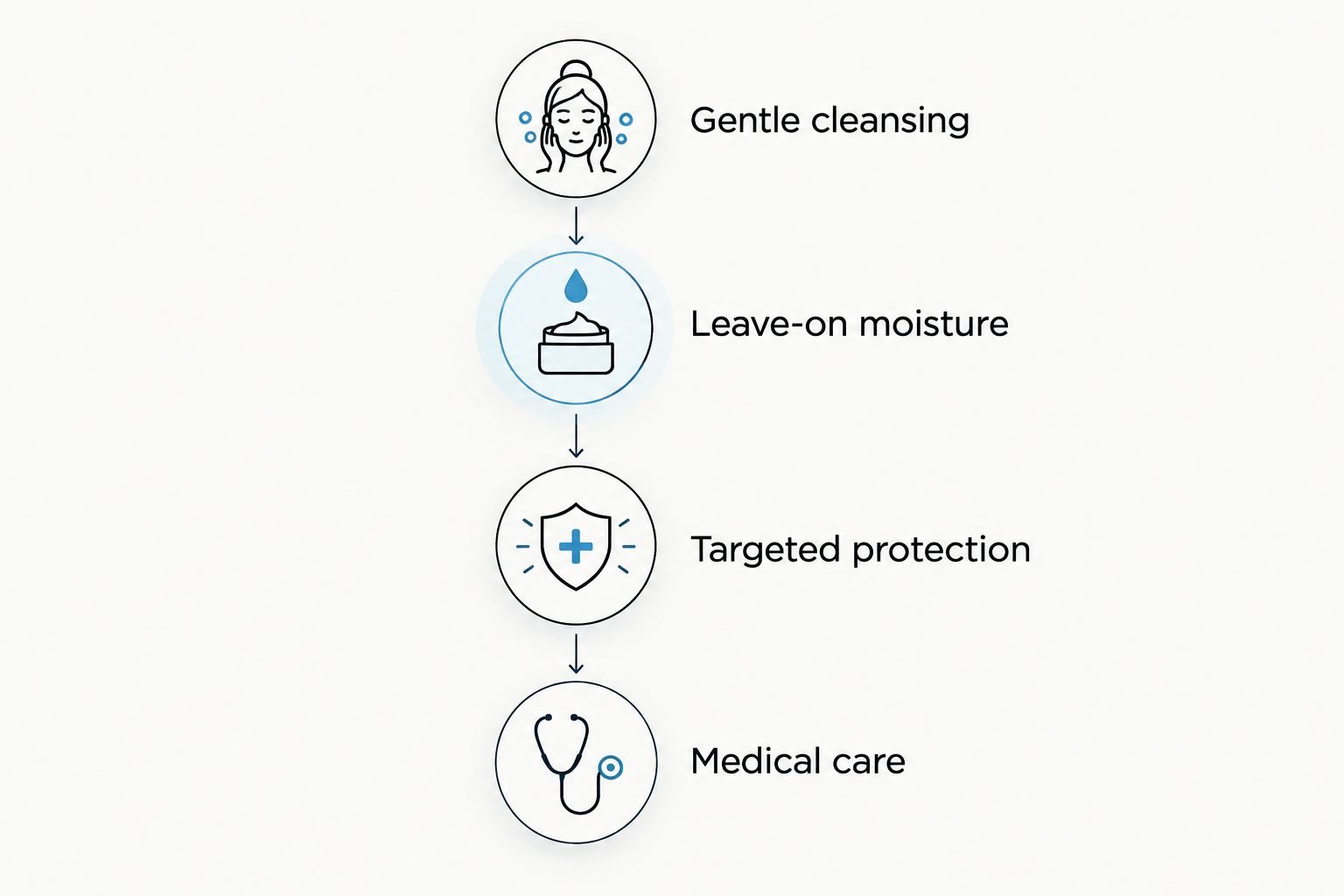
A useful 2026 routine starts with three decisions: how you cleanse, how you moisturize, and when symptoms need medical care. Keep optional exfoliants and fragranced skincare out of the experiment while your skin is irritated.
- Gentle cleansing: Use lukewarm water and a cleanser you already tolerate.
- Leave-on moisture: Apply a tolerated cream or ointment after washing, while skin is still damp.
- Targeted protection: Reserve a heavier ointment for patches that need extra moisture retention.
- Medical care: Follow your treatment plan and seek help for worsening symptoms.
The American Academy of Dermatology advises keeping baths or showers to 5–10 minutes and using warm rather than hot water. Moisturize after washing; prolonged hot-water exposure is not a shortcut to softer skin.
For a new skincare product, the Academy's home-testing guidance recommends applying it to a small test area twice daily for 7–10 days before broader use. This checks tolerance; it does not replace medical patch testing for contact allergy or prove that a product treats eczema.
Introduce products separately so you can identify the change if irritation appears. Stop using a product that causes a reaction. Oozing, crusting, spreading redness, significant pain, or other signs of infection need medical assessment rather than another cosmetic layer.
How these options were ranked
This ranking prioritizes moisture retention, fragrance avoidance, routine purpose, and personal tolerance. Plain petrolatum takes the default slot for very dry patches; creams serve daily moisturizing; a gentle cleanser serves washing rather than treatment.
The ranking does not assign clinical results to individual brands. It also does not equate natural ingredients with safety. A tolerated, straightforward formula beats a longer routine chosen for its labels.
Which eczema-prone skincare should you choose?
Choose plain petrolatum ointment for very dry patches and a fragrance-free cream for daily moisturizing. Add a gentle cleanser only for the washing step, and keep active eczema treatment under your clinician's guidance.
For 2026, make comfort and consistency your default. Your routine does not need to demonstrate how many products you own; it needs to avoid known triggers and support the care your skin actually requires.
FAQ
What's the best non toxic skincare for eczema?
The best non toxic skincare for eczema starts with a tolerated fragrance-free cream or ointment, not a non-toxic label. Plain petrolatum is a useful default for very dry patches, while fragrance-free creams suit daily moisturizing. Active eczema can also need medical treatment.
Is plant-based skincare better for eczema-prone skin?
Plant-based skincare is not automatically better for eczema-prone skin. Botanical ingredients, essential oils, and fragrance can cause reactions. Choose by the complete formula and your personal tolerance.
Can I use Grace & Rae Skincare if I have eczema?
Evaluate each Grace & Rae Skincare formula before using it on eczema-prone skin. Check the current ingredients for fragrance and your known triggers, and ask your clinician about products during an active flare. The brand's plant-based positioning alone does not establish eczema suitability.
Is an ointment better than a lotion for eczema?
An ointment generally retains moisture better than a lightweight lotion and is useful for very dry skin. Creams offer another option for daily care. Texture preference and tolerance help determine which you will use consistently.
Should eczema-prone skin avoid fragrance?
Fragrance-free skincare is the better default for eczema-prone skin. Unscented products can still contain ingredients used to mask odor, so check the ingredient list rather than relying only on the front label.
How do I test a new moisturizer on sensitive skin?
Test a new moisturizer on a small area before applying it broadly. The American Academy of Dermatology recommends twice-daily application to a test spot for 7–10 days. Stop if a reaction develops; this home check is not diagnostic allergy testing.
When should I see a dermatologist instead of changing skincare?
See a clinician when symptoms persist, worsen, disrupt sleep, or show signs of infection. Oozing, crusting, spreading redness, and significant pain need assessment. Cosmetic skincare cannot replace an eczema diagnosis or treatment plan.
One last thing
A simpler ingredient list helps you track changes, but it does not guarantee tolerance. Even a single ingredient can be wrong for a particular person.
Before your next purchase, write down the products your skin already tolerates and the ingredients that have caused problems. Bring that list to your clinician if reactions keep recurring. Your own history is more useful than another promise on a jar.