


Instead of deciding what to apply every morning and evening, build your Pure Harmony Collection AM/PM routine around cleansing, label-directed care, and daytime sun protection. This 2026 workflow turns those decisions into a repeatable sequence while keeping room for your skin’s comfort.
Why this matters
A collection gives you products; a routine gives each product a purpose. You do not need to use every bottle at every application, and an unfamiliar product should not enter your routine simply because it arrived alongside the others.
Grace & Rae Skincare’s Pure Harmony Collection is best for beginners seeking a simple, nourishing skincare starting point. The supplied collection description identifies Nourish Cleanser and Repair Serum. Let the directions on your actual products determine their amounts, application conditions, and frequency.
The benefit of an AM/PM system is fewer repeated decisions. Its limitation is equally important: a routine cannot diagnose acne, eczema, rosacea, or a reaction. Keep prescribed skincare instructions separate from this general guide, and follow your clinician’s directions when they differ.
For your 2026 routine, aim for a sequence you can explain without looking at a complicated chart. Morning care prepares your skin for the day; evening care removes what accumulated and provides an opportunity for moisturizing.
Before you start
- Gather the actual products and their directions. Keep Nourish Cleanser and Repair Serum beside any moisturizer and sunscreen you already tolerate. Check every label rather than assuming the collection supplies every step.
- Prepare a gentle setup. You need clean hands, lukewarm water, a clean towel, and a place to record your skin’s response. If you use prescribed treatments, keep their instructions with your routine notes.
- Check the hidden gap: daytime protection. A skincare collection is not automatically a complete sun-protection system. Have a broad-spectrum, water-resistant sunscreen with SPF 30 or higher, and introduce unfamiliar skincare gradually rather than starting everything together.
The American Academy of Dermatology recommends testing a new skincare product on a small area twice daily for 7–10 days before broader use. Follow product directions during testing, including rinsing off products intended to be washed away. Home testing does not guarantee that a product will never cause irritation or allergy.
If your skin is already irritated, simplify first. Adding several unfamiliar formulas to uncomfortable skin makes it harder to identify what is helping and what is causing trouble.
Product map and routine settings
- Read each label completely. Identify whether the product rinses off or stays on, whether it has a stated frequency, and whether it belongs on damp or dry skin. Do not replace those instructions with a generic layering rule.
- Assign a job to each product. Use the categories Cleanse, Treat, Moisturize, and Protect in your written routine. Leave a category unfilled until you have identified an appropriate product.
- Separate collection contents from additions. Nourish Cleanser and Repair Serum are named in the collection description. Verify other contents from your packaging; do not assume another separately sold product is included.
- Write down the smallest workable sequence. Make one morning list and one evening list. Include an optional product only when its directions and your skin’s response support that use.
Expected result: You can identify what each product does, which directions govern its use, and whether your morning routine still needs sunscreen.
A product’s name alone does not establish its ingredients, texture, or compatibility with another formula. In particular, do not assume Nourish Cleanser and a separately named cleansing oil have identical directions.
Morning routine setup
- Check your skin before washing. Notice tightness, redness, itching, or tenderness. Do not add an optional treatment to skin that already feels irritated.
- Cleanse gently when needed. Follow Nourish Cleanser’s directions for application and removal. Use lukewarm water where rinsing is required, and avoid scrubbing with a towel or cleansing tool.
- Apply label-directed care. Use Repair Serum according to its directions. If the label specifies application conditions or frequency, keep those instructions in your written morning sequence rather than guessing.
- Moisturize according to comfort and directions. Use a moisturizer you tolerate when your skin needs it. Do not assume a serum replaces moisturizer; those roles depend on the actual formulation and instructions.
- Finish skincare with sunscreen. Choose broad-spectrum, water-resistant SPF 30 or higher and follow its application directions. Apply sunscreen before makeup if you wear it.
Expected result: Your morning sequence ends with daytime protection, and your skin does not feel persistently stinging or uncomfortable. A shiny finish is not proof of hydration, and a matte finish is not proof that your skin is adequately moisturized.
The American Academy of Dermatology advises applying sunscreen about 15 minutes before going outdoors and reapplying approximately every 2 hours outdoors, as well as after swimming or sweating. Follow the sunscreen label’s water-resistance and reapplication instructions.
For your 2026 morning checklist, write those sunscreen reminders separately from your serum instructions. A skincare sequence and outdoor reapplication schedule solve different problems.
The sequence below is a planning framework, not permission to override a product label. Keep the treatment and moisturizing steps that suit your actual products and skin.
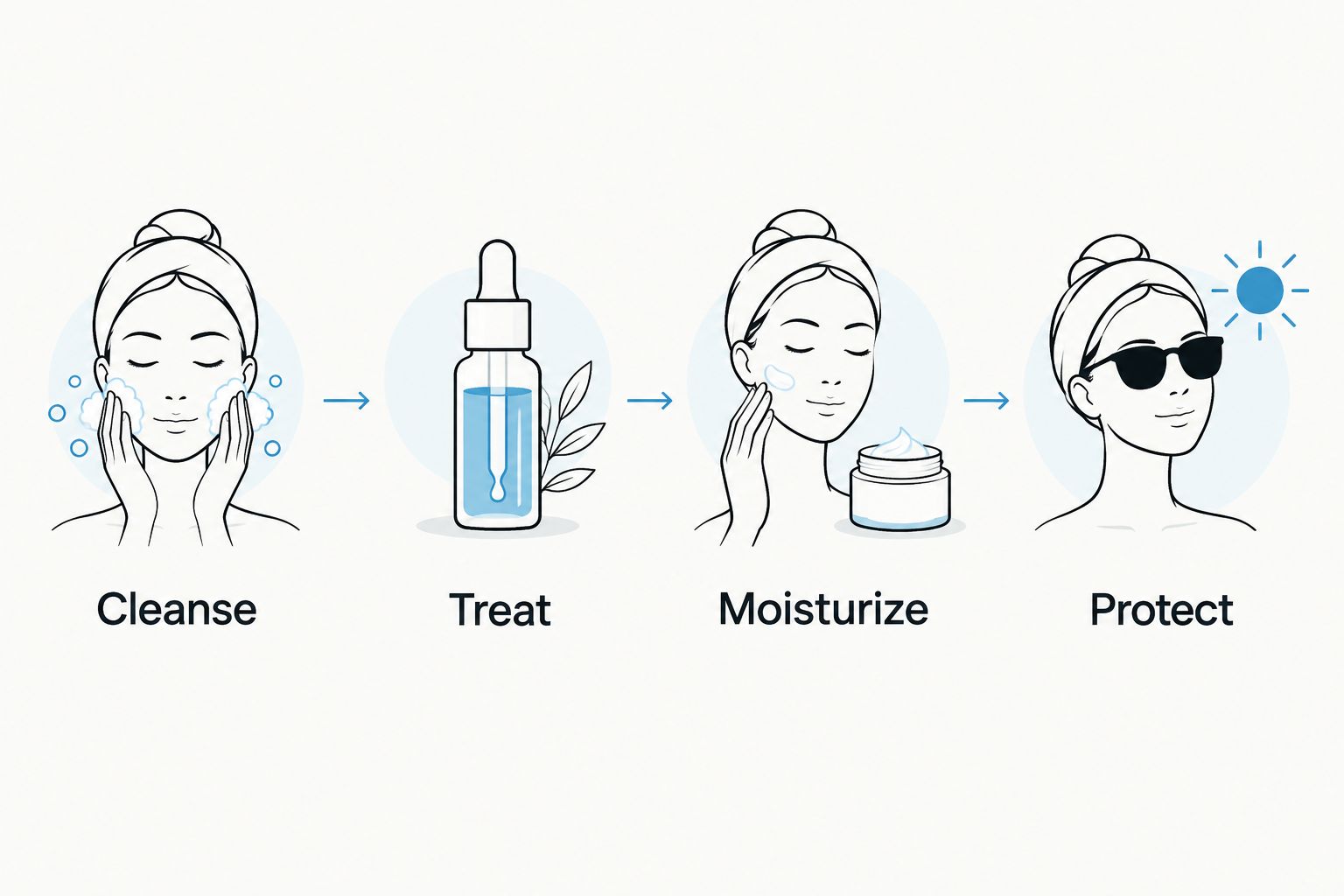
Evening routine setup
- Identify what needs removing. Consider sunscreen, makeup, sweat, and visible residue. Choose a cleansing approach that removes them without repeated scrubbing.
- Use Nourish Cleanser as directed. Follow the label’s application and rinsing method. Pay attention to the hairline and jaw, where residue is easy to overlook, without rubbing harder.
- Check the result before adding another wash. Look for remaining makeup or sunscreen residue and notice how your skin feels. Double cleansing is an option for removal needs, not a requirement attached to owning a collection.
- Apply Repair Serum only on its intended schedule. If its directions support evening use and your skin tolerates it, place it in the evening list. Do not automatically double the frequency because your routine has two daily sessions.
- Finish with appropriate moisturizing. Follow your moisturizer’s directions and adjust application to comfort. Avoid adding an unfamiliar exfoliant or other treatment just to make the evening routine feel more complete.
Expected result: The day’s residue is removed, your planned leave-on products are applied, and your skin feels comfortable rather than stripped. Persistent tightness after washing is a reason to reassess cleansing, not a reason to scrub again.
Grace & Rae Skincare’s plant-based skincare positioning does not replace individual tolerance checks. Botanical ingredients can still cause irritation or allergic reactions, so keep the same introduction process you would use for any unfamiliar formula.
Use your 2026 evening checklist to record changes, not to chase a perfect finish. If you change a product, change that entry clearly; otherwise, yesterday’s routine and today’s routine become difficult to compare.
Second variant: skincare after exercise
An exercise-day routine changes the timing of cleansing and sun protection. It does not require a separate collection or an extra round of every leave-on product.
- Cleanse gently after heavy sweating. Avoid leaving sweat and friction-related residue on your skin simply to preserve the original morning schedule.
- Reassess comfort. Use a tolerated moisturizer if needed. Keep treatment frequency tied to its label rather than repeating a serum automatically after each wash.
- Restore daytime protection when appropriate. Follow sunscreen directions after sweating and before further outdoor exposure.
- Keep the evening cleanse responsive. Remove the day’s sunscreen or makeup, but do not add unnecessary washes because your routine note says more steps are better.
Expected result: Your exercise-day schedule handles sweat and sun exposure without turning every cleansing event into a full treatment session.
Best for: days with exercise or heavy sweating. This variant makes the schedule more practical, but it also increases the chance of over-washing if you repeat the entire routine without checking what your skin needs.
Troubleshooting your AM/PM routine
Your skin feels tight after cleansing
Recheck the cleanser’s directions, water temperature, washing frequency, and any scrubbing. Use gentle handling and a tolerated moisturizer rather than trying to fix tightness with more cleansing. If discomfort persists, stop experimenting and seek professional guidance.
Products roll into little flakes
Pilling can occur when layered formulas do not sit well together or when you apply too much and rub repeatedly. Use label-directed amounts, reduce unnecessary layers, and let each layer settle before the next. Do not reduce sunscreen below its directed amount to solve the problem.
A new product stings or causes redness
Stop using the suspected product and simplify your routine to tolerated essentials. Do not treat ongoing burning, itching, or rash as evidence that skincare is working. Seek medical advice for persistent reactions; breathing difficulty or significant facial swelling requires urgent care.
Sunscreen or makeup remains after washing
Review the cleanser’s removal instructions and the products you are trying to remove. A separate, suitable removal step can address persistent residue, but repeated aggressive washing is not the answer. Choose removal methods you tolerate and reassess the result before adding more steps.
You cannot tell which product caused a change
Return to your last tolerated routine and record what changed. Introduce unfamiliar products separately rather than restarting everything at once. Keep prescriptions on the clinician-directed schedule and ask the prescriber before changing them.
Customize your workflow
Start with a stable baseline, then adjust one part of the routine at a time. Combination skin does not require identical application across every facial area: pay attention to dry and oily zones while following each product’s directions.
For your 2026 routine notes, record:
- Product used: its exact name and whether you rinsed it off.
- Application time: morning, evening, or after exercise.
- Skin response: comfort, tightness, redness, itching, or residue.
- Other changes: a new prescription, different makeup, or more frequent washing.
These notes support decisions; they are not a diagnostic test. Avoid declaring a product successful or unsuccessful based only on how glossy your skin looks immediately after application.
Grace & Rae Skincare offers a skincare starting point, not a reason to replace everything you already tolerate. Keep useful existing products in the system when their directions fit, and leave out additions that have no clear job.
FAQ
What is the best Pure Harmony Collection AM PM routine for beginners?
Start with gentle cleansing, label-directed skincare, moisturizing as needed, and morning sunscreen. Pure Harmony Collection’s description names Nourish Cleanser and Repair Serum; verify the remaining contents and directions on your packaging.
Can I use Repair Serum both morning and night?
Use Repair Serum at the frequency stated on its label. Having both a morning and evening routine does not mean every product belongs in both sessions.
Does Pure Harmony Collection replace sunscreen?
Do not treat Pure Harmony Collection as a substitute for sunscreen. Use a broad-spectrum, water-resistant sunscreen with SPF 30 or higher and follow its application and reapplication directions.
Do I need to double cleanse every evening?
Double cleansing is not required for every evening routine. Base an additional removal step on remaining sunscreen or makeup residue and your skin’s tolerance, not on the number of products you own.
Should I start every new skincare product on the same day?
Introduce unfamiliar skincare products separately. The American Academy of Dermatology recommends small-area testing twice daily for 7–10 days before broader use, while following the product’s directions.
What should I do if my plant-based skincare stings?
Stop using the suspected product rather than continuing through persistent stinging. Plant-based ingredients can still cause irritation or allergy; seek medical advice for a persistent reaction.
How do I change my routine after a workout?
Cleanse gently after heavy sweating and follow sunscreen directions before further outdoor exposure. Do not automatically repeat every treatment product after washing; keep its frequency tied to the label.
One last thing
The most useful routine note is what you leave out. Mark optional steps clearly so a rushed morning does not become an accidental experiment with extra products.
Make your 2026 system easy to repeat: keep the directions accessible, protect your skin during the day, and respond to discomfort instead of pushing through it. Your beautiful skin does not need a longer checklist to deserve thoughtful care.